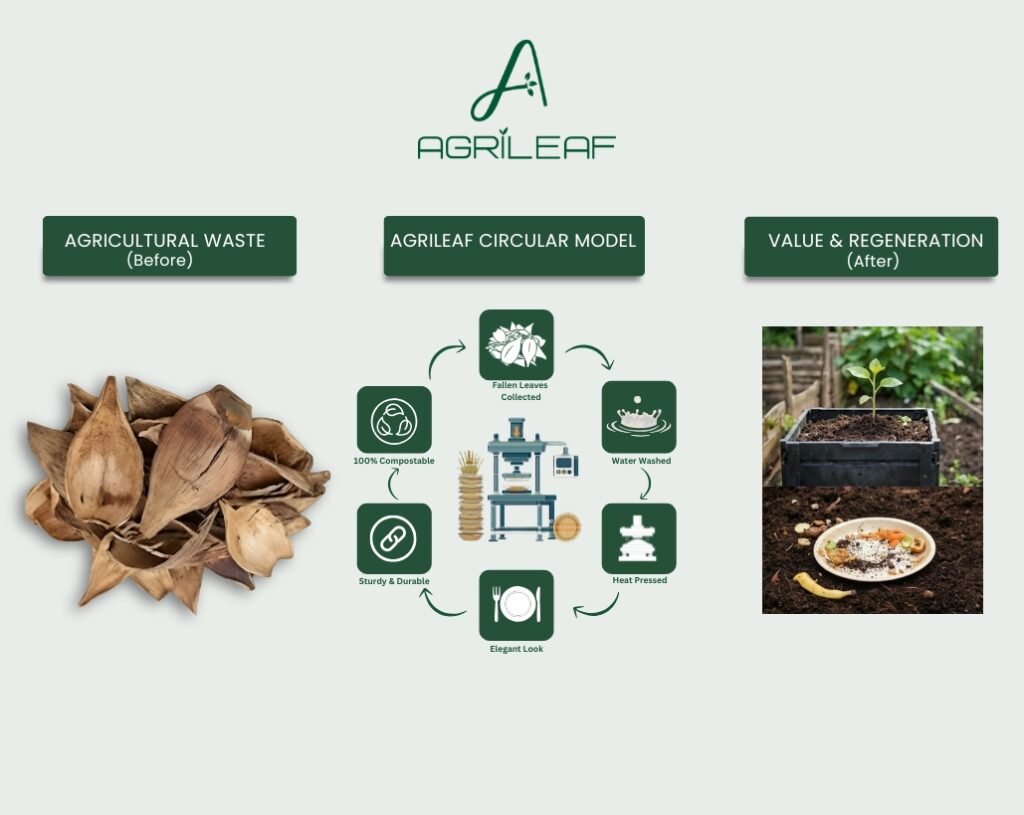
Across India’s farms, vast amounts of agricultural by-products—areca sheaths, paddy straw, coconut husk, banana fibre and more—are generated every season. Most of this material is burnt or discarded, causing environmental harm. At Agrileaf, we view this biomass not as waste, but as a renewable resource that can power rural livelihoods and circular manufacturing.
From Waste to Value
Agrileaf’s circular model begins with the collection of naturally fallen areca sheaths, which are sourced directly from farmer cooperatives across Karnataka. Instead of decomposing or contributing to open-burning, these sheaths become the raw material for our biodegradable, chemical-free tableware.
Rural Impact & Sustainable Sourcing
By purchasing fallen sheaths, Agrileaf helps farmers earn supplemental income, while nearly 70% of our workforce—primarily rural women—gain stable employment. This creates a regenerative, community-oriented value chain.
Challenges in Collecting Eco-Waste in India
Implementing this model is not without hurdles. Key challenges include:
- Fragmented farms that make large-scale collection time-consuming
- Seasonal variability in sheath availability
- Lack of organized rural aggregation points
- Transportation difficulties in remote areas
- Farmer awareness gaps, requiring continuous training on quality, storage, and handling
Despite these obstacles, Agrileaf invests in local partnerships and field teams to maintain consistency and traceability.
Closing the Loop
Once collected, the sheaths are cleaned, heat-pressed, quality-tested, and exported. After use, the products naturally decompose within weeks—completing a zero-waste cycle.
Agrileaf’s journey proves that when agricultural residue is valued as a resource, it strengthens rural economies while nurturing a regenerative, circular future for India.