Circular Economy in Action: Turning Agricultural Waste Into Value – The Agrileaf Way

Circular Economy in Action: Turning Agricultural Waste Into Value – The Agrileaf Way

Across India’s farms, vast amounts of agricultural by-products—areca sheaths, paddy straw, coconut husk, banana fibre and more—are generated every season. Most of this material is burnt or discarded, causing environmental harm. At Agrileaf, we view this biomass not as waste, but as a renewable resource that can power rural livelihoods and circular manufacturing.

From Waste to Value

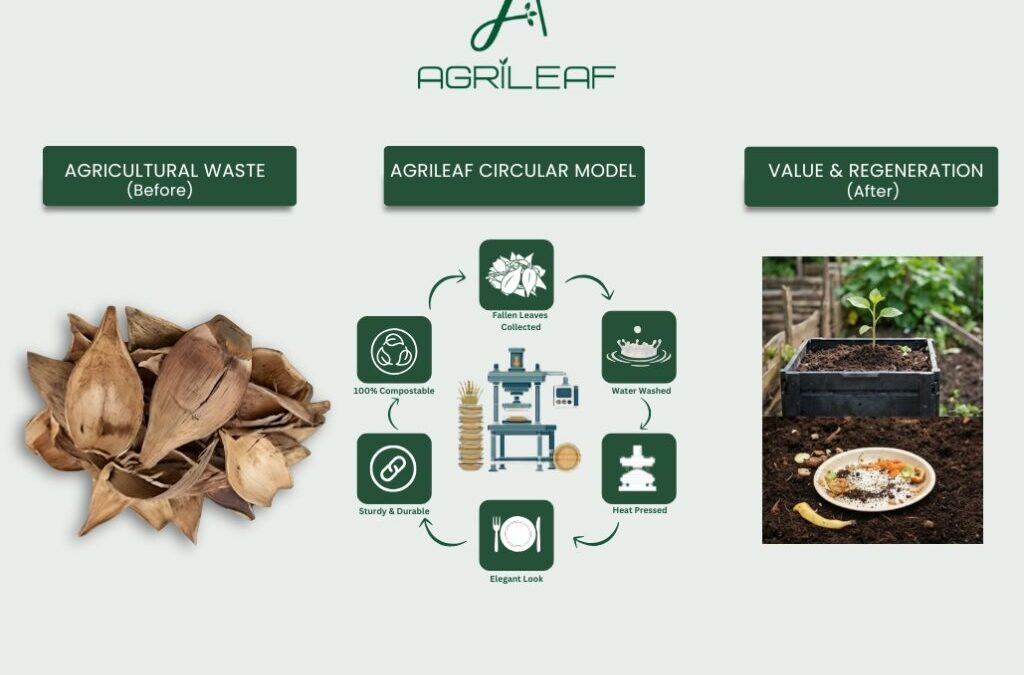
Agrileaf’s circular model begins with the collection of naturally fallen areca sheaths, which are sourced directly from farmer cooperatives across Karnataka. Instead of decomposing or contributing to open-burning, these sheaths become the raw material for our biodegradable, chemical-free tableware.

Rural Impact & Sustainable Sourcing

By purchasing fallen sheaths, Agrileaf helps farmers earn supplemental income, while nearly 70% of our workforce—primarily rural women—gain stable employment. This creates a regenerative, community-oriented value chain.

Challenges in Collecting Eco-Waste in India

Implementing this model is not without hurdles. Key challenges include:

  • Fragmented farms that make large-scale collection time-consuming

  • Seasonal variability in sheath availability

  • Lack of organized rural aggregation points

  • Transportation difficulties in remote areas

  • Farmer awareness gaps, requiring continuous training on quality, storage, and handling

Despite these obstacles, Agrileaf invests in local partnerships and field teams to maintain consistency and traceability.

Closing the Loop

Once collected, the sheaths are cleaned, heat-pressed, quality-tested, and exported. After use, the products naturally decompose within weeks—completing a zero-waste cycle.

Agrileaf’s journey proves that when agricultural residue is valued as a resource, it strengthens rural economies while nurturing a regenerative, circular future for India.
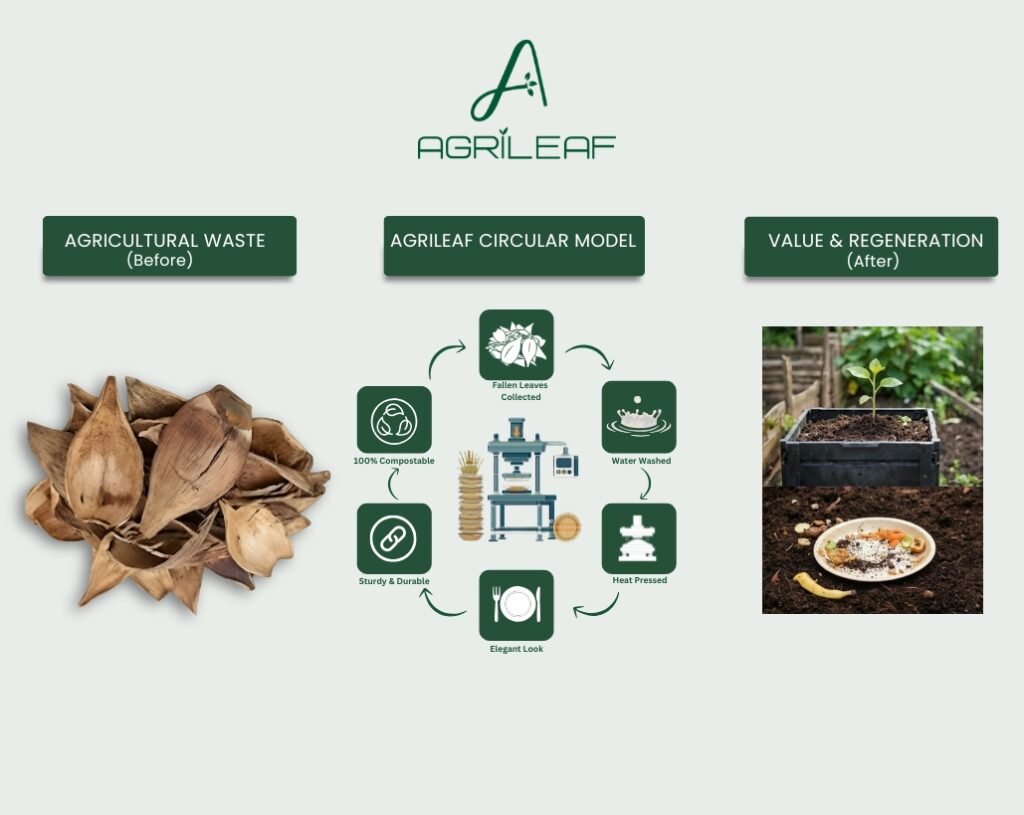
Agrileaf model

How palm leaf plates are more natural, and how quickly it can compost when compared to other bio-degradable alternatives

How palm leaf plates are more natural, and how quickly it can compost when compared to other bio-degradable alternatives

How palm leaf plates are more natural, and how quickly it can compost when compared to other bio-degradable alternatives

Without a doubt, palm leaf plates are a more environmentally friendly alternative to plastic or paper plates. Palm leaf plates are made from fallen palm leaves, and they are tough and resistant to heat. In addition, Bio-based palm plates are compostable and biodegradable. The majority of compostable plates and disposables are made from bagasse, bamboo, recycled paper, corn starch, and even fallen leaves. Biodegradable plates and cutlery are better for the environment because they do not leave toxic chemicals or residues behind. Furthermore, as time passes, these products degrade, releasing earth-friendly nutrients back into the soil.

How are Palm Leaf Plates Made?

A palm leaf plate is a more environmentally friendly alternative to a single-use paper plate. It is made from fallen areca palm tree palm leaves that have been gathered, cleaned, and pressed into shape.

Compostable palm leaf plates

Palm trees are primarily found in Southeast Asia and parts of Africa. Throughout the year, they frequently shed their leaves. These yellow-brown sheaths are collected and transferred to a manufacturing company where they are trimmed, stacked, and cleaned with fresh water. The manufacturer then presses and molds the sheaths into various shapes.

Bio-based palm plates do not require the cutting down of trees as they are made from fallen leaves. They are also durable and long-lasting, making them an excellent choice for any occasion and certain to impress your guests. When used with dry foods, these dinner plates can be wiped clean and reused despite being commonly used as disposable dinnerware. Disposing of used plates and food waste is simple since areca palm leaf plates are compostable and biodegradable, ensuring that they will never end up in a landfill. Composting these leaves at home is very simple as the leaf plates decompose naturally in 45 to 60 days, leaving nothing but nutrient-rich compost for your plants. What comes from nature returns to it.

Compostable leaf plates are made from collected leaves that are hand-pressed and then sanitized to promote hygiene. The manufacturing process does not use glue, synthetic adhesive, or anything else. Not only are the plates themselves environmentally friendly, but the manufacturing process is also eco-friendly.


How Do You Compost Palm Leaf Plates?

Palm leaf plates, as their name suggests, are made of tightly compressed leaves that have been shaped into plates. Bio-based palm plates compost on their own in a matter of days and are especially notable because they do not rot on Earth. However, if you want to benefit from the composting of palm leaf plates, there certainly is a way. There are numerous practical advantages to composting, such as the fact that the compost is highly nutrient-rich for soil. If you have a pile of biodegradable plates, you should begin composting them to reap their environmental benefits.

Because they are made of palm leaves, the composting process is extremely simple and does not require any special equipment. It can be done at home in your backyard without the need for professional assistance. The composting of palm leaf plates will take between 6 and 8 weeks to complete. Cut the palm leaf plates into smaller pieces and store them in a smaller container to speed up the process. Ensure that it is stored in a container with a smaller surface area. Also, choose a composting container that can maintain the internal temperature of the composting material stable. It is critical to keep the container cool and dry so that the microorganisms can effectively kill and degrade the material, transforming it into a valuable and nutritious rice mixture.

While biodegradable plastic emits fewer harmful chemicals when broken down, this does not imply that it is without risk. Certain types of biodegradable plastic can emit harmful substances such as metals and methane. Overall, palm leaf plates are a natural and environmentally friendly alternative to traditional disposable plates, and they compost quickly and easily without harming the environment


Agrileaf palm leaf plates are simple to use and light in weight. The plates are edged with a raised layer to make them more comfortable to use. The product is suitable for children.

Enquire now for best bulk prices